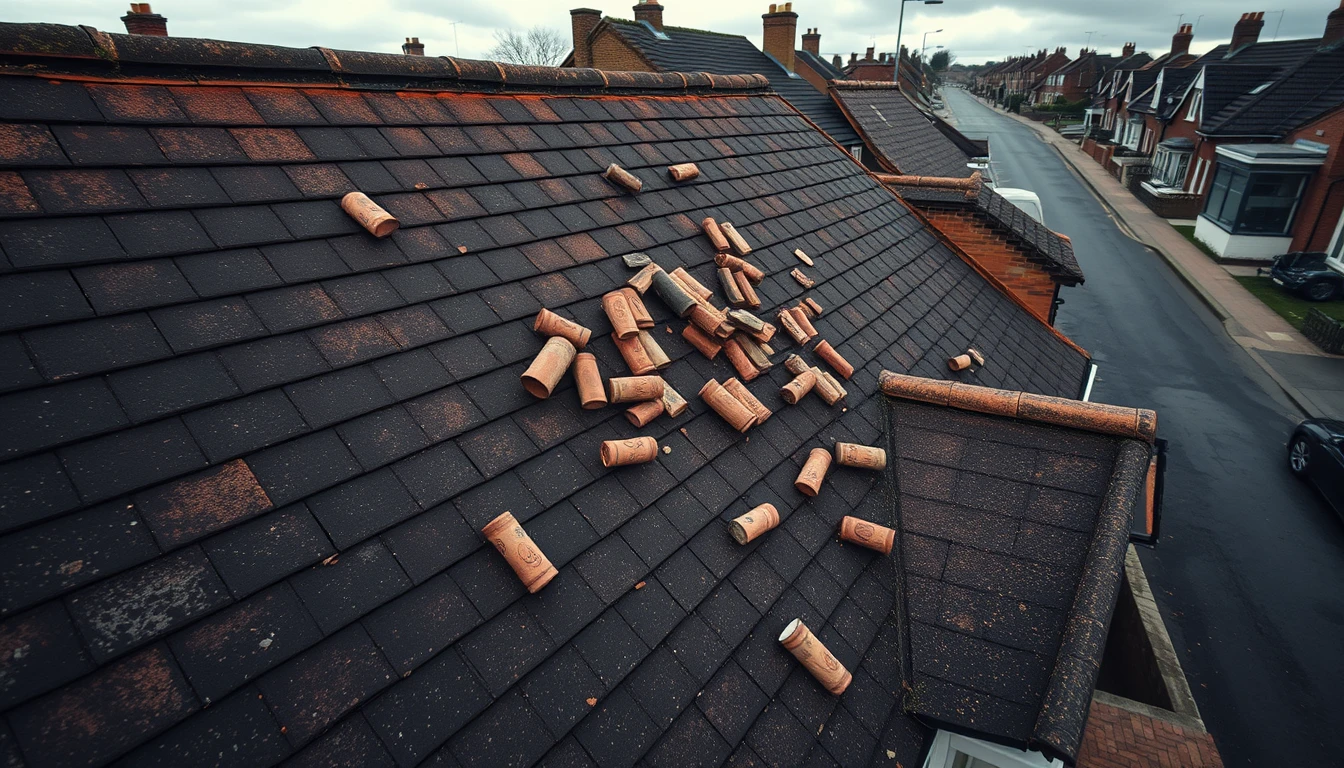
The morning after a windy night, most people look up from the street. If nothing looks obviously broken, they decide everything’s fine. That’s a reasonable first step, but it misses a lot. Wind damage is often only visible from specific angles. It’s sometimes not visible from ground level at all, which is exactly why a proper check still matters.
Start in the garden, not on the roof
You don’t need a ladder for the first pass. Walk the perimeter of the house and look at what’s landed:
- Debris on the lawn or patio — small fragments of tile, slate, or ridge mortar are the clearest sign something’s come loose up top, even if you can’t see where from.
- Gutters and downpipes — check what’s collected in the gutter and what’s spilled onto the ground below it. A sudden pile of grit or moss at the base of a downpipe often means a tile has shed its surface, or a joint has failed.
- Fence lines and flower beds downwind of the house — wind-blown debris travels, so check beyond the immediate footprint of the building.
Look at the roofline from a distance
Stand well back, across the street if you can, and scan the roof slopes and ridge line:
- Gaps in the tile pattern — a missing or slipped tile shows as a dark rectangular gap, or a tile sitting at an odd angle next to its neighbours.
- A wavy or uneven ridge line — ridge tiles are bedded in mortar, and that mortar can crack, letting a ridge tile shift or lift in high wind.
- Flashing that’s visibly lifted or peeling away, around chimneys and where a roof meets a wall. Lead that’s come away from the brickwork often catches the light differently, showing as a pale strip or shadow line from the ground.
- A chimney stack that looks slightly out of true, or pots that look displaced compared to how they usually sit.
Check inside the loft
This is the step people skip most often, yet it’s the one that catches problems the outside check misses entirely:
- Daylight coming through anywhere it shouldn’t — even a pinprick of light is worth looking into, since it means there’s a gap somewhere in the covering.
- Damp patches or staining on the felt or rafters, especially around chimney breasts and roof valleys, where flashing failures show up first.
- A musty smell or visibly wet insulation, which can mean water has been getting in for longer than a single storm.
Why an inspection still matters even if nothing looks wrong
Some of the most common storm damage genuinely isn’t visible without getting up there. A tile can crack without shifting position, and a nail can work loose without the tile falling. Flashing can also lift a few millimetres at the top edge. None of that is visible from the ground, yet it’s enough for water to start tracking in over the following weeks. Most reputable roofers recommend a proper inspection after any spell of high wind. Storm damage often shows up as a leak weeks later rather than straight away.
That difference matters beyond the repair itself, since insurers tend to treat damage left to develop for weeks differently from damage reported promptly. Our guide to insurance cover for storm damage explains why an early report protects your position. It helps either way, even if nothing turns out to need doing.
A quick note on ladders and roof access
None of the checks above should involve you getting on the roof yourself. A pair of binoculars, or a zoomed-in phone camera, tells you almost everything a ground-level check can. Roofers use proper access equipment, such as tower scaffolding or a roof ladder secured over the ridge, for exactly this reason. Still, a five-minute professional inspection beats checking it yourself from an ordinary ladder against the gutter line.
What happens after you spot something
If you find debris, a visible gap in the tiles, or daylight in the loft, don’t assume a full repair is next. A same-day or same-week inspection lets a roofer confirm what’s actually happened first. Some cases are genuinely urgent, such as an active leak or a tile about to come off completely. A temporary make-safe stops things getting worse. A tarpaulin or a secured loose tile now, and a proper roof repair once it’s scheduled, is standard practice after storms. Rushing a full repair in poor weather tends to cost more than doing it properly once conditions allow. It’s also worth checking whether your gutters and fascias took any damage at the same time. Our guide to repairing versus replacing guttering, fascias and soffits covers how to tell the difference.
If the roofline check turned up gaps or cracked tiles, it’s worth reading our guide to signs your roof needs replacing. Storm damage sometimes reveals a roof that was already close to the end of its life. Similarly, if you have a flat-roofed extension or garage, flat roofs behave differently in high wind. It’s worth a separate look at that covering too.
Emergency roof repairs don’t need to wait for a leak to actually start. A same-week inspection, and a temporary make-safe where needed, is far cheaper than a ceiling repair after water’s been getting in unnoticed. If water is already coming through, our guide to what to do when your roof is leaking covers the immediate steps. And this rundown of what actually counts as an emergency helps if you’re not sure.
We cover Bracknell and the wider Thames Valley, including homes around Camberley, Wokingham, Henley, Maidenhead, Newbury and Basingstoke. If high winds have been through your area recently, get in touch rather than guessing from the pavement. Get a free quote, and we’ll tell you honestly whether it’s a repair or nothing to worry about.